Tom Thorn investigates the cottage which once stood in Well Wood, learns about the people who lived there and discusses the likely origins of the woods’ name
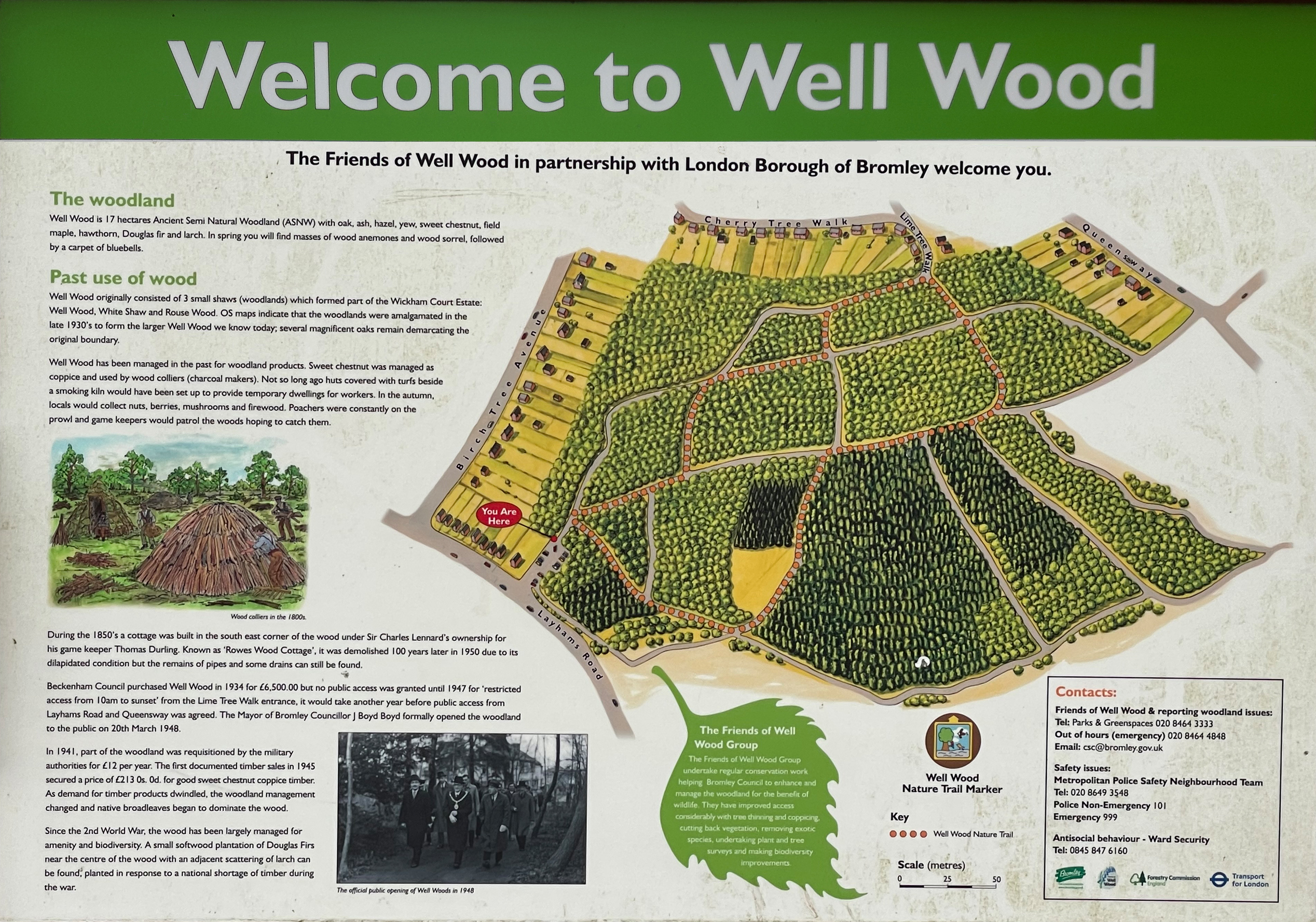
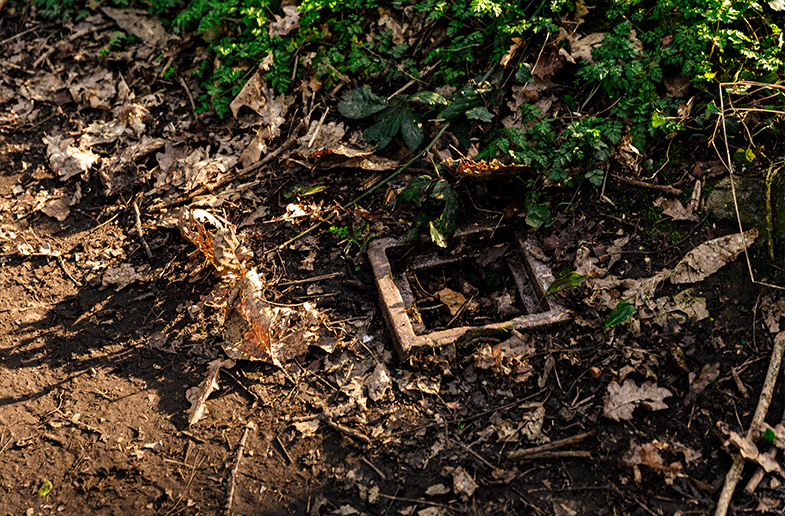
There has been much interest in the fact that Well Wood once had a cottage for the resident game keeper. Although the cottage is long gone, signs of it can still be found in the south-east corner of the wood: parts of the drainage system, pieces of broken china and ditches which seem to show the outline of a filled pond. As the pond still has a water-resistant clay liner, the paths which cross it are often boggy in winter time. There is also a line of hawthorn trees in the wood, which may be a hedge line for an access track, avoiding the pond.
Well Wood was originally made up of three smaller woodlands, Well Wood, White Shaw and Rouse Wood, and was part of the Wickham Court Estate. The cottage was built on the instruction of Sir Charles Farnaby, when a Mr Thomas Durling was appointed as his first gamekeeper – that’s him, in the photo above with his family.
The cottage had no running water, so the Durlings used either the pond or a well. Thomas and his descendants lived in the cottage until the last of his five children, Edward, died in 1933.
In 1934, Beckenham Urban District Council agreed to buy half of Well Wood, including the cottage, for £6,500. But by 1948 the cottage was in a poor state and renovation was deemed too expensive. A replacement was built in Layhams Road and the new keeper moved into the new property in late 1953. The old cottage was demolished, having stood for over 100 years – and the pond was probably filled in at the same time.
Well Wood may not be named after a water well, but after chalk wells (or dene holes) in and around the woods. These are vertical shafts dug into the earth to reach the chalk layer beneath, which is opened out into an underground mine. Good quality chalk was in high demand at the time, usually applied directly to the fields for soil improvement. Once depleted they were backfilled – and they have a habit of collapsing. The location of any in Well Wood is unknown, which is another good reason for sticking to the paths!
Although Elsy and James Borders (of mortgage strike fame) campaigned for public access to Well Wood in 1938, it wasn’t opened fully to the public until 1948. Even after the public were allowed in, part of the wood was fenced off for many years as a bird sanctuary. Below is a report by the West Wickham Field Club on 21st October 1945 of their inaugural trip to Well Wood, and it gives some indication of how the woods once were.
Field Club Report: 21st October 1945
Permission has been obtained to visit Well Wood, Layhams Road, and thicher the party set their course in steady rain.
We found the Keeper awaiting us at the gate and after admitting us he was so good as to devote the rest of the morning to conducting the party round the wood. Both the season and the weather militated against observation of wild life but various tit bits of information imparted by the keeper made up for this barrenness.
The stump of cherry tree which he pointed out to us was all that remained of what a previous Parks Superintendent claimed was the largest Cherry tree in the country. Some years ago there was an article in a local paper about this particular tree and the keeper later showed us a framed photograph of the tree with himself standing near it which had been reproduced with the article. The tree had been broken down by a gale some years ago.
Turning to the subject of wild animals he told us that though rabbits were formerly plentiful in the wood so many had been killed off by the Canadian artillerymen quartered in and about the wood during the war that comparatively few remained. Foxes, on the other hand, had increased considerably and were now too plentiful. He had himself shot a number recently. Grey Squirrels also are plentiful but the Red Squirrel has not been seen there for some years. Badgers, he told us in answer to a question were not to be found in Well Wood but there were some in the neighbouring Bradmanshill Wood. Magpies frequent the wood and had taken a number of his Chickens and goslings.
After collecting a number of sizeable chestnuts in the wood the party left through a gap in the fence near the Keeper’s cottage and reached home again at about 12.30, the rain having ceased during the morning which incidentally was followed by a fine afternoon.
A timeline of Well Wood Cottage
1851 – ‘Gamekeeper’s cottage, Nash, West Wickham’, is first mentioned in the census, occupied by Thomas, his wife Hannah and children
1871 – The cottage was known as ‘Rows Wood Cottage’, and Thomas, now a widower, was living with his married daughter and family.
1881 – Thomas was still living in the cottage, now listed as ‘Rowes Wood’.
1889 – After Thomas died in 1889, his son Richard took over as gamekeeper – but he also died just a year later.
1890 – Tom’s other son Edward then took over and continued to live in the cottage (the place of his birth) until his death in 1933 aged 86.
1934 – A new keeper, Mr Rugman, 38, was employed on a wage of £2 7s 6d.
1945 – A request to redecorate the cottage and to connect it to electricity was turned down, being deemed uneconomical
1953 – The cottage is finally pulled down, after a replacement is built on Layhams Road (by what is now the car park entrance to Well Wood)
 Coney Hall Village Residents' Association (CHVRA)