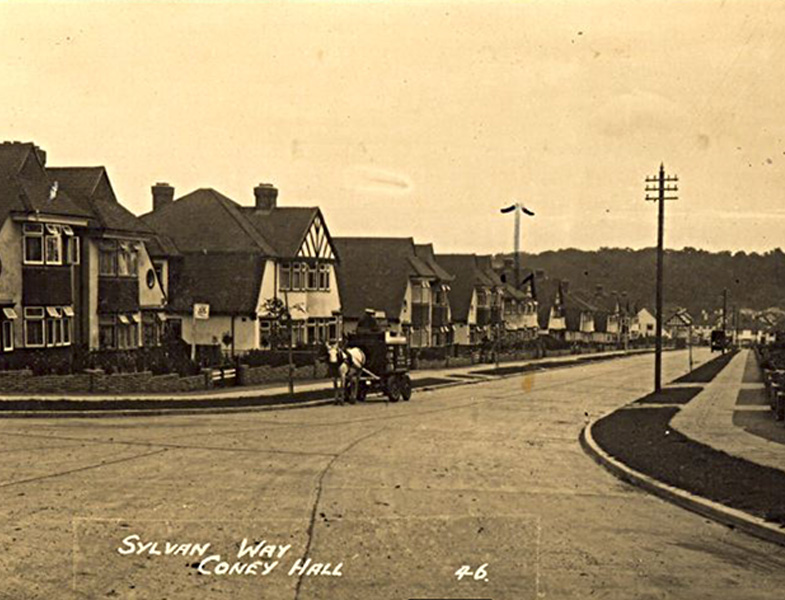
Local resident Martin Gardiner has been delving into the history of one of Coney Hall’s ‘newer’ roads and has uncovered some fascinating facts
I’ve been researching my family tree for some time now and kept coming across the 1939 Register, which provides a rich source of information. One day, on a whim, I realised I could look up who lived in my house in 1939 – and by extension, who else lived in the road I live in today. I then thought people living in Coney Hall would be interested in who had been living in their homes before.
Note: as many current residents are likely to be descendants of those living here in 1939, I’ve chosen not to provide all the details available in the Register for this article.
A snapshot of 1939
The 1939 Register provides a snapshot of the civilian population of England and Wales just after the outbreak of the Second World War. It was designed to capture the details of every member of the civilian population on a specific date: 29 September 1939 (military personnel were not recorded). It contains details of around 40 million people, recorded in more than 65,000 volumes of transcript books.
The 1931 census for England and Wales was destroyed by fire during the Second World War and no census was taken in 1941. So the 1939 Register provides the most complete survey of the population of England and Wales between 1921 and 1951, making it an invaluable resource for family, social and local historians.
The information recorded on 29 September 1939 was used to produce identity cards and, once rationing was introduced in January 1940, to issue ration books. Information in the Register was also used to administer conscription and the direction of labour, and to monitor and control the movement of the population caused by military mobilisation and mass evacuation. The Register was then retained and updated to form part of the NHS records from 1948 onwards, so additional details were added such as changes to married names.
How to access and search the Register
It is only digital copies of the 1939 Register that are available to the public. You can search for and view open records on Findmypast.co.uk (charges apply). A version of the 1939 Register is also available at Ancestry.co.uk (charges apply), and transcriptions without images are on MyHeritage.com (charges apply). It is free to search for these records, but there is a charge to view full transcriptions and download images of documents. You can view these records online free of charge in the reading rooms at The National Archives in Kew.
Who’s in the Register records?
For each individual the details recorded include: full name, address, date of birth, marital status and occupation. Not everyone was recorded, and the armed services were recorded separately. It’s also possible that people were recorded away from their normal home as they were living apart from their families. By 29 September 1939 there had already been mass evacuations of the population, so many people may be listed in an entirely different location to the rest of their family. Many seasonal workers, such as hop-pickers, were still in the countryside when the Register was taken, and not at their normal home addresses in urban areas.
What does this mean for Coney Hall?
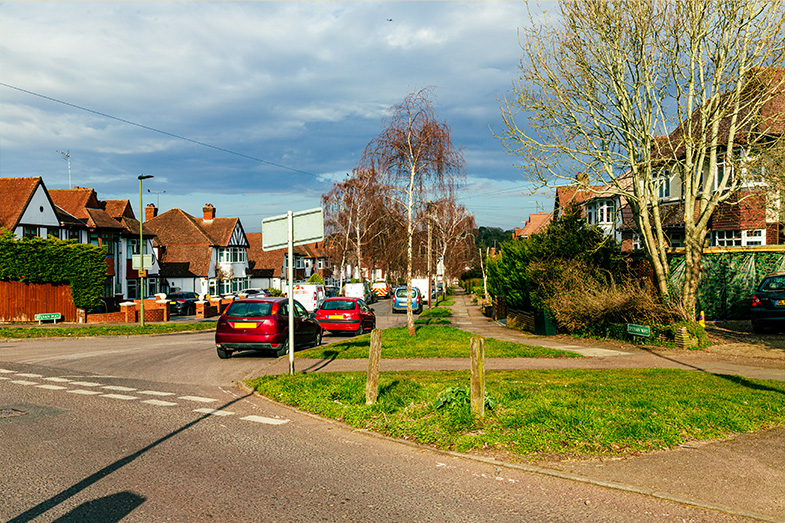
In 1939 Coney Hall was still a new area and some properties were still unsold and vacant. Streets were completed on different timetables and to different designs. Sylvan Way has a range of building styles different to those in other parts of Coney Hall – and fortunately for this research, it’s not one of the longer streets!
The newness of the area is reflected in the profile of the people living here, with broadly a younger family profile. There aren’t many old people and many homes are occupied by married couples in their 30s. In total there are 52 houses in the road; numbering on the even side goes from 2–48 and on the odd side from 1–53, meaning numbers 50, 52 and 54 are ‘missing’ (something I only noticed doing this). In 1939 there were nine houses that appear empty, with the remaining 41 homes occupied by 150 people (an average of 3.6 per household).
As a number of records for people who may still be alive are closed, there’s a little bit of uncertainty over the balance of males and females. However, we can identify that there are 53 females and 67 males – leaving 30 children who we can’t identify. Of these we can see there are 40 married couples (there’s one person who is married but their spouse is not recorded – so I’m assuming they may have been away, possibly on active service). There are six people identified as being widowed and only one divorcee.
The average age of the 120 people where we can identify their birth year is 36.8. The oldest person in the street lived at number 19, and she was an 87 year old widow living with her son and daughter-in-law. The next oldest in line was at number 22, and she was a 72-year-old widow living with her single 34-year-old daughter. Across the street at Number 23 was a 71-year-old widower living on his own.
| Age range | Number of residents |
| Under 20 | 49 |
| 20 to 49 | 75 |
| 50+ | 26 |
A broad range of occupations
Only five women were recorded as being in paid employment, and for the most part, they’re recorded as performing unpaid domestic duties. The employed women were all under 31.
There was one market gardener (recorded as such with her husband – so this may even be an error given the times); one shop sales assistant (working in a shoe shop), a food warehouse packer, a ledger clerk in the furnishing trade and one seeking work. This imbalance would change as the war progressed and men were drafted into the military; women would take up the slack in the job market.
There were a range of jobs held by the men of the street, broadly categorised into Blue Collar (21), Commercial (28) and Government roles (4). We had three civil servants, three commercial travellers, two gardeners, four butchers (or assistants), three working for the bus companies, two railway workers, two company secretary/accountants, two compositors, two general dealers (!), two carpenters and two sheet metal workers.
There was also one billiard hall owner, bank clerk, company director, foreman electrical manufacturer, farmworker, garage manager, gas fitter, draughtsman, general labourer, licensed stock-taker and ganger, motor driver, heating engineer, radial driller, radio worker, shipping clerk, shop keeper, friendly society superintendent, technical engineer, window cleaner former, a business owner and one regular army officer. So a spread of working people, probably much as today.
As mentioned, there were nine empty properties, so some of those living in the fuller houses would have possibly looked on with envy. At number 1 there were eight people sharing the house: two parents in their late 40s and their six children aged from 21 down. There are also eight people sharing Number 10 – again a married couple and their children aged from 25 down.
Number 16 has a three-generation household of six people: grandparents, parents and children. Two other households have six people, including Number 31, where our oldest resident lives along with one of the few children identified, who was two years old in 1939. At Number 42, two married couples shared their house with one child – it’s unclear if they were related.
There were five people sharing Number 4: a married couple and their three children. There are also five people sharing Number 9 – which seems to be a mixed household. The remaining properties have smaller numbers, with a number of two-person households occupied by young couples. As an example, at Number 28 a young couple were both in their 30s: the husband a civil servant with relations living in Birch Tree Avenue. Eventually they would go on to have three children and move away from the area, relocating to Hampshire. They had both lived in different areas of London before moving to Coney Hall, including Stoke Newington, Battersea and Kensington.
Many people have now lived in the area since their families moved in here the 1930s, whereas others are relative newcomers, like the original residents. Such as myself, here a mere 30 years!
War-time volunteers
A number of men are recorded as Air Raid Precaution wardens. The Home Guard had not been raised at this point, but air raids were a concern of the government. There were also people registered as ambulance drivers or stretcher bearers. There were seven ARP wardens, two medical volunteers, three special constables or police reservists and one member of the regular army – a major in the Royal Artillery.
Family names
Surnames of the families living in the road in 1939 are shown in the table on the table below. Some people reading this may recognise names, though there are rather a lot: 49 in all across 41 occupied homes.
| Surname | Number in Family |
| Allen | 2 |
| Barber | 2 |
| Barnett | 3 |
| Bateman | 4 |
| Beale | 1 |
| Betteridge | 2 |
| Carter | 6 |
| Charters | 3 |
| Christopher | 1 |
| Cleasby | 3 |
| Clift | 1 |
| Copping | 2 |
| Cullen | 2 |
| David | 3 |
| Davies | 1 |
| Duckett | 4 |
| Etheridge | 2 |
| Eve | 2 |
| Faircloth | 4 |
| Fielding | 1 |
| Fisher | 6 |
| Fletcher | 3 |
| Gillmartin | 2 |
| Goodman | 5 |
| Harrison | 1 |
| Hilkin | 2 |
| Hobbs | 2 |
| James | 2 |
| Lambert | 3 |
| Mealin | 2 |
| Miles | 2 |
| Mortimer | 4 |
| Oates | 4 |
| Pickering | 1 |
| Poulton | 2 |
| Pullen | 2 |
| Simmonds | 1 |
| Smith | 4 |
| Stanley | 4 |
| Staples | 3 |
| Steadman | 2 |
| Tettmar | 2 |
| Thompson | 1 |
| Tucker | 2 |
| Unwin | 1 |
| Wheeler | 4 |
| Williams | 2 |
| Witham | 2 |
| Wragg | 1 |
 Coney Hall Village Residents' Association (CHVRA)