
Admittedly, it’s the winner from 1934, but Jonathan Moore takes a look at what makes it so special.
Tucked away behind the trees on the corner of the Croydon Road cut-through, it’s easy to miss number 77 Addington Road. But it’s a building that’s worth pausing to appreciate, whether you’re stuck in traffic outside or just strolling by.
As a temporary home to the West Wickham Library, this is a majestic building; a grand survivor from the Modernist/Art Deco design period of the 1930s. Understated and graceful (despite the purely functional low-rise extensions that have been hacked onto it over the years), this ‘Olympia Suntrap’ design deserves its Grade II listed status.
Previously, we told the story behind the building that currently houses Wickes on Croydon Road. Originally the jewel in the crown for Morrell’s Builders (the firm who commissioned and built the Coney Hall estate), the original purpose for the Wickes building was as a sophisticated cabaret and dining venue – the height of fashion in the 1930s. Number 77 was built at the same time and designed in the ‘International Moderne’ style by the same renowned architects, Leslie Kemp and Frederick Tasker. Number 77’s design has serious cachet: a built example was first displayed at the Ideal Home Exhibition of 1934 in a showcase area titled ‘The Village Of Tomorrow’, where it won that year’s Daily Mail Ideal House competition.

Interestingly, all the houses in the show-village were modernist: flat-roofed and plain walled, with both angular and curved corners and not a hint of the mock-Tudor style so typical at the time. But in the end only three domestic examples of the Olympia Suntrap were ever built, all of which are still standing: our own building in Coney Hall, another in Herne Hill and the third, surprisingly, in Dublin.
The important thing to remember is just how different this house was from anything else around at the time. 90 years ago, for the majority of Britons electricity was a novelty, piped gas an aspiration, an indoor toilet a luxury and hot water on tap a dream. Coney Hall’s houses, although well appointed compared to
a lot of contemporary builds, still expected residents to take coal deliveries to heat fireplaces and boil water. But the Olympia Suntrap? This was a truly modern, forward-looking house, leaping ahead decades in the expectation of how people could live. Everything about it feels contemporary to now, not almost a century ago.
Hopefully some of you will have already been into Number 77, either to visit the library, or via one of the Open House viewings the take place in mid September. Although the interior has been altered in recent times, you still get a real sense of how it would have been to live there and many of the original features and details are still intact.
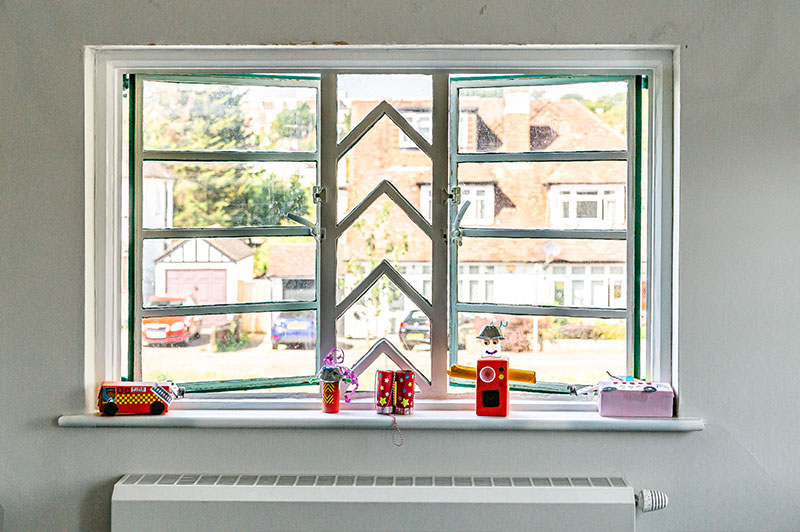
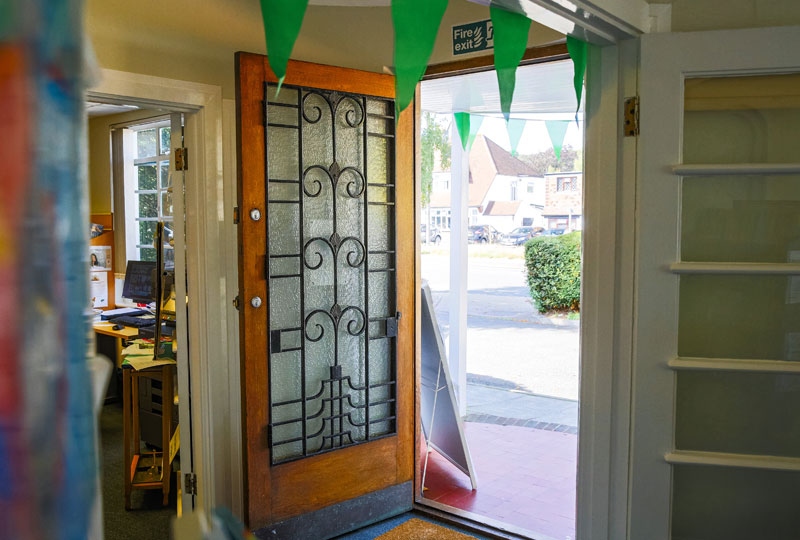
Morrell’s marketing listed it as a four-bedroom detached house with attached garage block. Its exterior: ‘rendered brick with flat sun-roof and chimney stack attached to staircase turret’. The angular outline is full Modernist, reinforced by metal-framed Crittall windows with small, horizontal-pane glazing. Not that they were called windows in the blurb, mind – but ‘light casements’! Almost the only nod to traditionalism is the oak surround of the front door – but then it’s brought back into ‘Moderne’ territory with its ornate cast-iron scrolled grille and the tall scrolled side-lights that flank it.
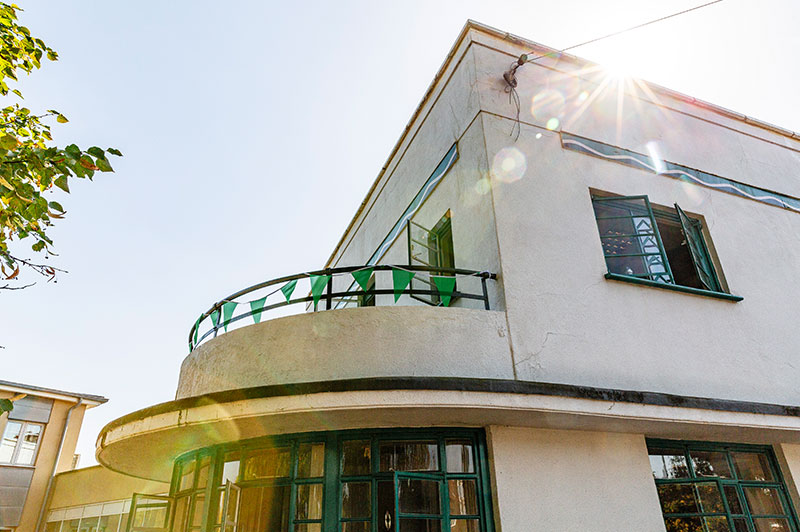
On the first floor, what was the master bedroom opens out onto an opulent curved sun balcony on the left of the house, with metal railings arcing round its length like on the deck of a ship – another typical Art Deco tick also used on the Wickes building. Directly below, the curve is echoed and extended with the outline of the living room and its widescreen, five-bay ‘light casements’.
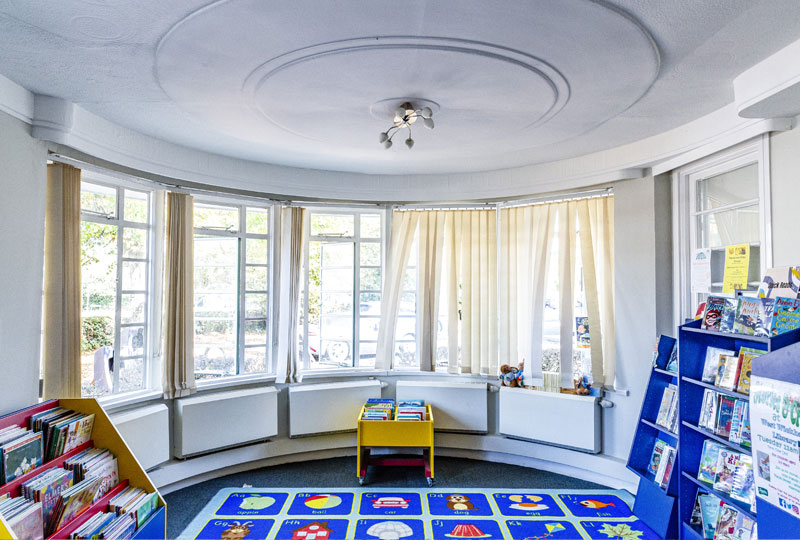
The maple-floored downstairs rooms have glazed double doors. An interesting feature is that the hall, study, dining room and lounge could all be opened out to create one open-plan space – ideal for throwing the ultimate party. Many features were built-in from the start: window seats under the bay in the living room; cupboards, bookshelves and a table. The fully-fitted kitchen even featured a ‘telephone enclosure’. This was challenging stuff for people to get their Georgian heads round.
Upstairs, the bedrooms all had built-in cupboards and there was a full-length mirror on the landing. The bathroom was also non-traditional, fully-fitted with Vitrolite panelling (a pigmented, structural glass that was great for hygienic surfaces but also used to face the exteriors of many iconic Art Deco buildings). Morrell’s marketing described the ‘coloured porcelain bath of the finest and most modern design, with chromium-plated fitments and a recessed soap dish’, ‘walls panelled in Vitrolite and glass of varying colours’ plus ‘an outstanding feature: a separate shower enclosure’. At number 77 the original bathroom has been repurposed into an office, but a glimpse of the original design survives: through a break in a stud wall you can peak through to see the original green and white striped Vitrolite wall and even some original floral wallpaper.
The rear elevation is now shrouded by the modern extension, but would have featured a porch and a tall window framing the staircase. The right side would have had the tradesmen’s entrance and garage block. The flower border that arcs round the ground floor aspect was also part of the original design, terminating elegantly either side of the front door in stepped piers. The flat roof was also accessible, via a small construction which housed the water tank. It’s also likely that the roof was ringed by a metal balustrade, in the same style as the sun balcony.

Number 77’s sister in Herne Hill provides fantastic insight into what the interior would have originally looked like. That house has always been a domestic property, and its recent listing by Historic England gives us a protected time capsule to compare with our own Olympia Suntrap.
A Historic England spokesperson said: “This is a remarkable survival which transports us back to the architectural ideals of the 1930s where ‘dignified simplicity’ was favoured over excessive ornamentation.”
The problem was that in 1934 the general public just wasn’t ready for such an architectural leap forward. The following year’s Ideal Home Exhibition featured just one house in the Moderne style, and it’s no surprise then that so few Suntraps were commissioned in Coney Hall. The Wickes building, Number 77 Addington Road and the half dozen smaller ‘BJ Suntrap’ houses on Gates Green Road are a glorious and stark contrast to the mock-Tudor style used across the majority of the estate.
If you weren’t previously aware of number 77, now you have a good reason to visit: especially to take advantage of the library services while they’re so local to us!
 Coney Hall Village Residents' Association (CHVRA)