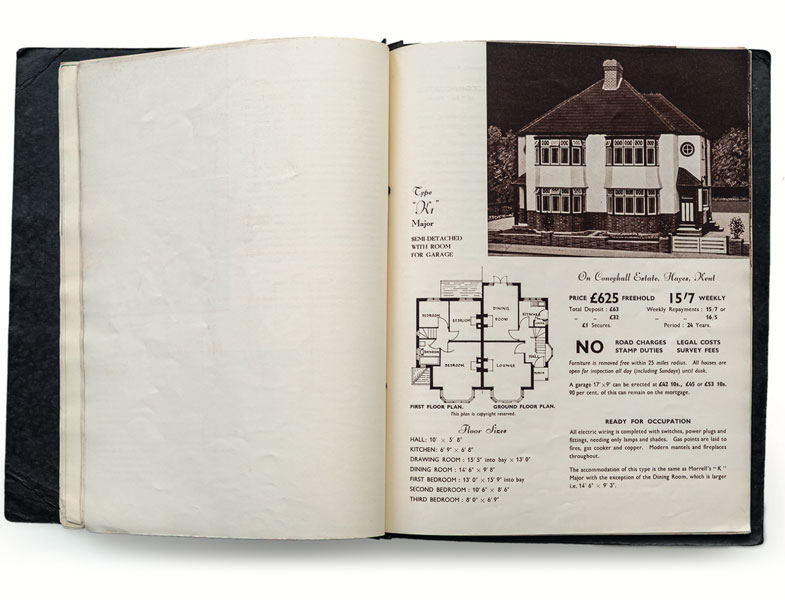
Local resident Jonathan Moore takes a look at what you could buy for £625 in Coney Hall, in 1933.
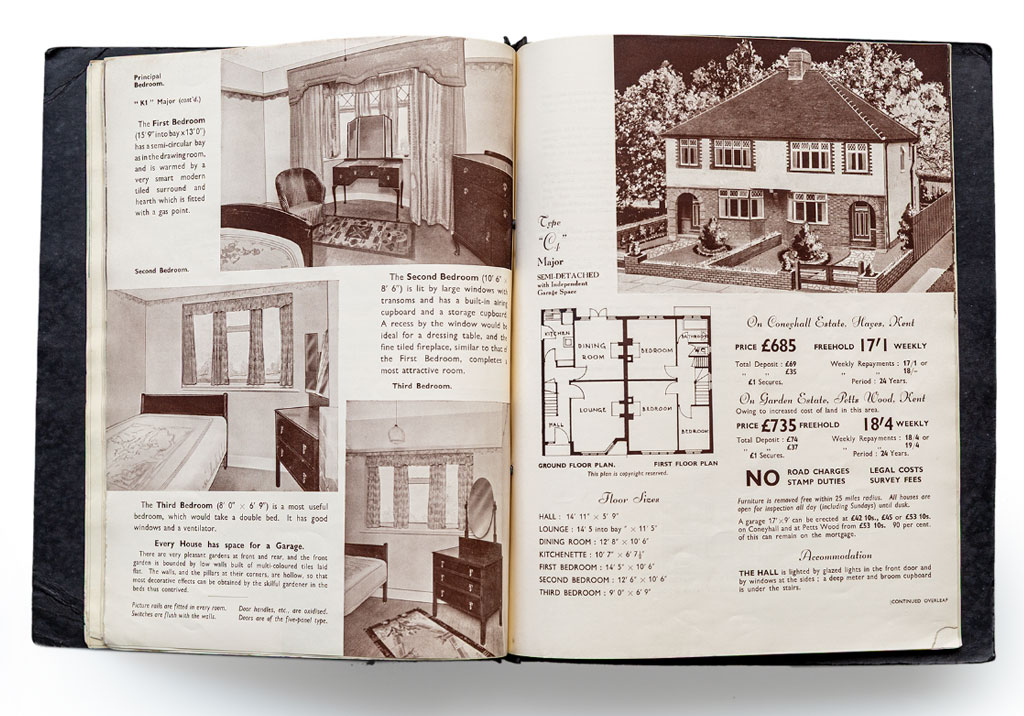
The Residents’ Association is fortunate to have access to a copy of the original 1933 sales brochure issued by Morrell Brothers, the building firm behind the Coney Hall estate. The brochure shows off the 11 main house types which were built across the Morrell Brothers’ two London developments in Petts Wood and Coney Hall, though minor variations were also introduced during the build programme.
Although the idyllic descriptions in the brochure could be said to match the location more than the final buildings (leading to local campaigner Elsy Borders pioneering legal case), it’s interesting to see the pristine presentation and aspirational details of the houses being built. Every house type gets a minimum of two pages, listing its price and the facilities delivered as standard, as well as photography and floor-plans.
Previously, we looked at the semi-detached J2 Major model; this time we’ll look at the J2’s slightly larger three-bedroom sibling, the K1 Major. From a scrub round the area on Apple Maps, these two houses would seem to be the dominant type across the original estate plan; it would be interesting to know if a full audit was ever done of the number of different models built. With so many houses extended or heavily modified it can make identifying the base design quite challenging. The K1 was offered for a very reasonable £625 freehold. That’s the equivalent of a startlingly cheap sounding £57,162.84 today – another reminder of runaway house prices in recent decades.
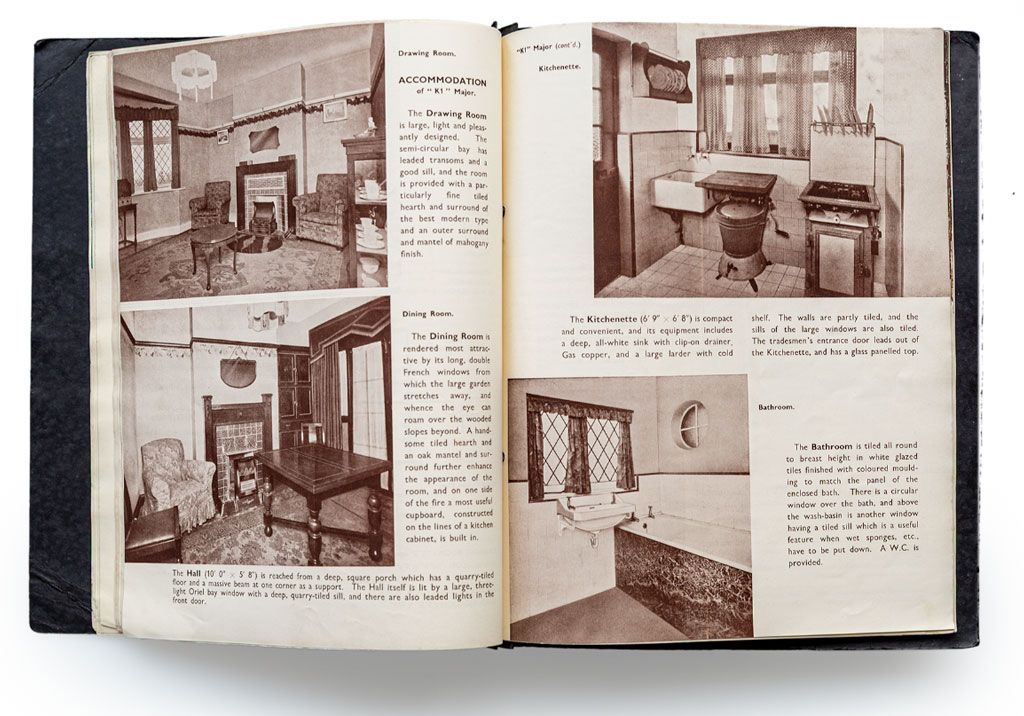
Morrell promised no road charges, legal costs, stamp duty or survey fees, and it’s the only other house in the sales brochure to feature promotional photography of the interior rooms, all freshly furnished to show off each room to its best. These shots really give you a sense of how it was to live at the time. It’s always fascinating to read about all ‘modern design’ references in houses which retained such a throwback Tudor aesthetic – especially when so few of the truly contemporary, International-style Suntrap houses were built in Coney Hall. That said, the Morrells installed many mod-cons that were truly ground-breaking for the era, including gas supplies laid to the kitchen and fires, and the houses were wired for electricity throughout. However, central heating was still many decades away so the main rooms still had fireplaces, and coal deliveries were expected.
The K1’s big bay windows at the front of the house, in the Drawing Room and Main Bedroom, are a design typical across Coney Hall. Once again, there’s a real bridging of tastes, as ‘modern’ glazed tiling around the fireplaces is counterpointed by the medieval-style leaded diamonds on the front windows. Glazed tiles and heavy wood was very much on trend, but as ever, it’s the kitchen and bathroom where the contrasts with today are most starkly observed: a minimalist oven, gas copper and the reference to a tradesman’s entrance in the former; and the fact a WC is ‘provided’ in the latter – but at least that meant no more having to brave the outdoors!
 Coney Hall Village Residents' Association (CHVRA)