Today’s update is from Sarah Chant, from Environmental action Coney Hall (EACH). If you have something the community should know about, let us know.
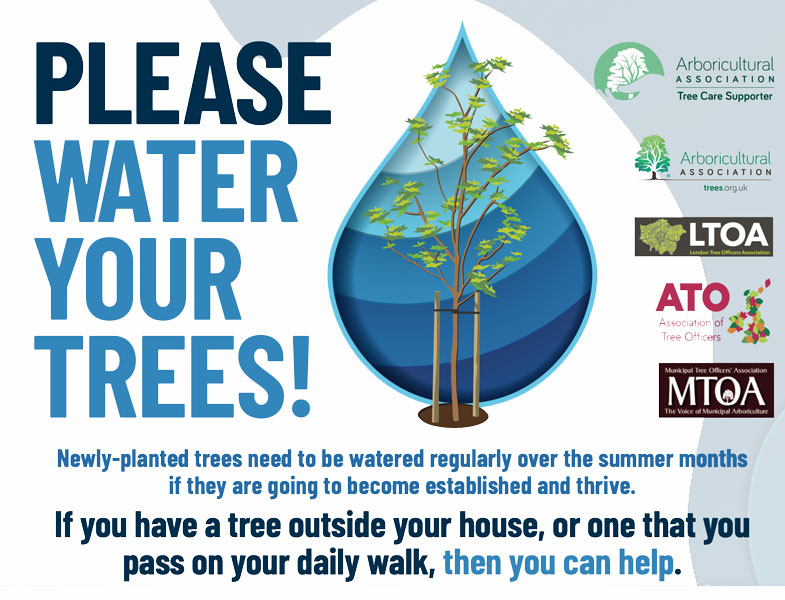
I realise that quite apart from suffering ourselves, we are all struggling to keep our gardens alive in this heatwave but please spare a thought for our young street trees.
As our climate changes, we need to adapt and prepare for extreme heat. In addition to making our streets look beautiful, trees provide much needed shade. When you next walk down your street, look at the young trees and you will see that many of them are struggling to survive.
Bromley did well to plant so many new trees in Coney Hall but the downside of the council’s effort to provide shade as well as a source of carbon and heat capture is that these trees all need watering!
Bromley Council does have a watering programme for all new trees planted for years 1-3: around 50 litres per week from May to August, sometimes later. This is supplied by the council’s contractors. However, the council has to water trees in the parks as well as the streets across the borough. This is obviously a mammoth task so residents are being encouraged to provide additional water during hot or dry periods.
There has been a change to Bromley’s tree policy in recent years and tree officers now apply a “right tree, right place” approach when selecting street trees. Thus, when choosing a species, council officers have to consider issues we may think are obvious now but clearly weren’t always before.
For example:
- The width of the pavement, underground services, nearby buildings and roads.
- Avoiding species that will become too large for the location.
- Planting trees with root systems which minimise future damage to footways, highways and nearby properties. Bromley’s Tree Management Strategy specifically acknowledges that some past planting choices were unsuitable. For example, the shallow root systems of the Norway maple trees planted on pavements often cause damage to pavements and highways.
- Risk of subsidence, particularly on Bromley’s clay soils.
- Long-term sustainability – whether the species is likely to thrive and reach maturity in that location. This in particular looks at the impact of the wet winters/prolonged droughts/extreme temperatures we’ve seen in recent years and likely to witness in the decades ahead.
- Biodiversity and species diversity – maintaining a varied tree population rather than relying heavily on a few species. This is particularly important in light of diseases we have seen such as Ash die back.
For the tree nerds amongst us, these are the most climate resilient trees being planted by our council, although there is a recognised need for further diversity.
- Acer monspessulanum
- Acer tataricum
- Arbutus unedo
- Cupressus arizonica
- Cupressus macrocarpa
- Eucommia ulmoides
- Olea europaea
- Ostrya carpinifolia
- Parrotia persica
- Quercus frainetto
- Quercus ilex
- Quercus suber
- Sorbus torminalis
- Tamarix ramosissima
Water is a precious resource and it does not come cheap but not only is it sad to see our trees dying, it is also a dreadful waste of council money. Our Coney Hall ‘Tree Friends’, Mr and Mrs Rickard have been watering trees in Coney Hall for years and we should be very grateful for their dedication. However, now that we are lucky enough to have more new trees, it is becoming too difficult for them to do this vital job on their own.
If we all adopted the tree outside of our house and poured a watering can of water a couple of times a week into the green bag or straight on to the soil a couple of times a week, we could save them. Why not use grey water from a washing up bowl for this good cause?
Please report any trees which you think are particularly suffering from lack of water or from damage of any sort to Fix my Street.
Many thanks
Sarah Chant (EACH)

